Why OKLCH makes a fairer hue game
PlayChainle’s Hue Game interpolates every board in perceptual OKLab/OKLCH color space rather than raw sRGB, preventing muddy gray dead zones in the middle of a gradient.
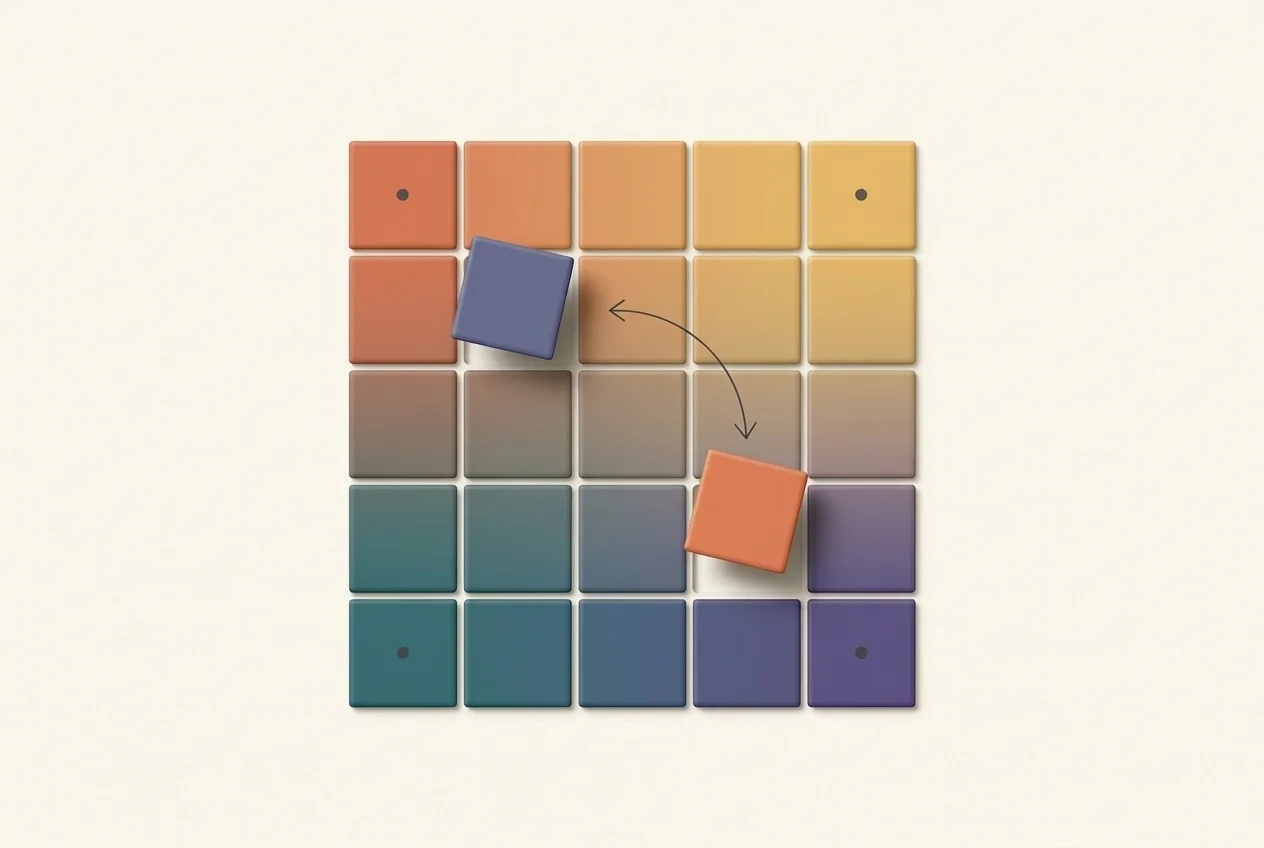
Many browser color sorting games blend corner colors linearly in sRGB. When blue meets yellow or coral meets teal in sRGB, the middle tiles collapse into dull brown-gray swatches that look nearly identical even on a good monitor. Using the open-source culori color library, every row and column here steps through perceptually even lightness and chroma intervals so your eye judges real hue shifts rather than math artifacts.
→ Ready to sort today’s perceptual palette? Jump back to the grid ↑
Par swap scoring and visual benchmarks
Every daily 5×5 board starts with 21 scrambled tiles and a calculated Par between 12 and 20 swaps, measuring your move efficiency against the shortest mathematical solution.
Instead of showing a raw move counter with no context, PlayChainle decomposes the starting scramble into permutation cycles before your first click. Start by anchoring the four outer edges—top row, bottom row, left column, and right column—because edge tiles vary along only one axis. Once the frame holds together, the nine interior tiles fall into place with far fewer swaps.
How this daily color puzzle compares to Huedle and hex guessers
People searching for Huedle or a color guessing game usually run into three distinct formats: 2D gradient sorting grids, 1D color strip sorters, and single-swatch hex or HSL guessers.
If you enjoy calm visual arrangement like I Love Hue without mobile ads or app installs, a 2D gradient grid gives you two axes of color reasoning at once—hue shift horizontally and lightness or warmth vertically. Hex and HSL guessers test color-code memory instead.
| Format | Core skill tested | Typical session | Best for |
|---|---|---|---|
| 2D Gradient Grid (PlayChainle) | Relative hue, lightness, and neighbor harmony | 2–4 min (4×4, 5×5, or 6×6) | Calm daily color sorting with instant practice presets |
| 1D Color Bar Strip (Huedle strip) | Single-axis lightness or hue ordering | 1–2 min | Quick warm-up along one linear spectrum |
| Hex / HSL Color Guessing Game | Absolute RGB/HSL value recall | 2–3 min (6 tries) | Front-end developers practicing hex code intuition |
→ Prefer a bigger challenge? Switch to Practice and try Fine 6×6 ↑
Display limits and when this color puzzle is a poor fit
Hue Game is a casual daily browser puzzle—not a clinical color-vision test like the Farnsworth-Munsell 100-Hue exam, and display hardware directly affects tile separation.
- Night Shift, True Tone, and heavy matte screen protectors flatten subtle blue-green and warm-ochre differences, especially on Fine 6×6 practice boards.
- Color vision deficiency (CVD): Because tile identity depends on hue and chroma transitions, red-green or blue-yellow color blindness can make certain daily palettes indistinguishable. The Grid labels and Spot misplaced controls help, but this game cannot replace accessible shape-based puzzles like Patternle or Logicle.
- No cross-device cloud sync: Daily progress is stored locally in this browser by UTC date with zero account requirement, so switching from phone to desktop starts a fresh local board.
Technical questions about today’s gradient
- How is the Par swap count calculated on each board?
- Par equals the exact mathematical minimum number of tile swaps required to restore the starting scramble, computed by permutation cycle decomposition (movable tiles minus disjoint cycles). Matching Par means every swap placed at least one tile into its final slot.
- Why do Night Shift, True Tone, or blue-light filters affect difficulty?
- Warm screen filters compress the blue-yellow axis and lower local contrast between neighboring shades. Turning off Night Shift or Eye Comfort mode for two minutes makes subtle green and violet transitions easier to separate.
- When does the daily gradient reset and how is progress saved?
- A fresh 5×5 daily board opens at 00:00 UTC for all players. Your current tile order, move count, and hints are saved in local browser storage by UTC date; practice boards stay separate and never alter your daily run.
Solve the 5×5 UTC daily board or spin up unlimited Calm, Classic, and Fine practice grids.