
Poople Strategy: Find a Shorter Route to POOP
Poople strategy with checked COLD and BOOK routes. Compare legal first moves, spot detours, understand Par, and practise each method in Poople Unlimited.
Last updated:
The short answer
To find a shorter Poople route, plan from POOP backward, look for a legal bridge from your current word, and keep checking the remaining distance after each move. The best-looking word is not always the best next move. A valid route only needs to change one position and use a word in PlayChainle's accepted list. This guide uses fixed practice examples, not the current daily answer.
Start with the Poople daily word ladder when you want the live board. Use this page when you want to understand why one route is shorter than another.
What a legal move tells you
A Poople move changes exactly one of four positions. The new entry must also be a four-letter word in the frozen accepted list. Changing two letters, adding a letter, reordering a word, or submitting the same word does not advance the route or the move count.
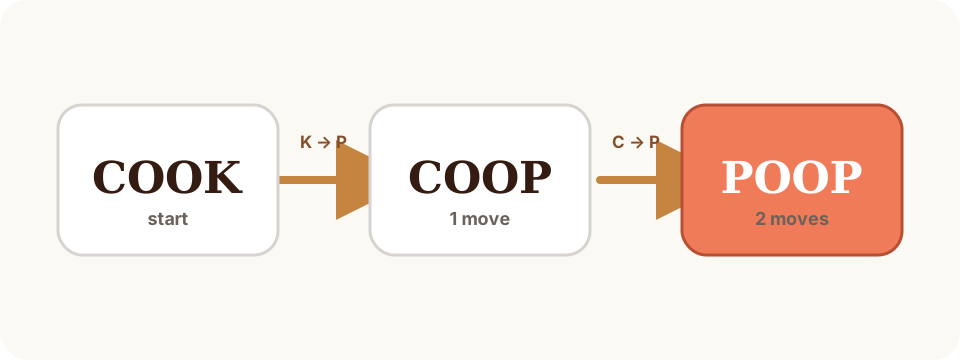
That rule gives you a useful test before you think about strategy: compare the two words position by position. If the current word is COOK, COOP is legal because only the last letter changes. COOK to POOP is not legal because the first and fourth positions change. In the game, an invalid entry stays in the draft and explains what needs fixing.
The word list is specific to this PlayChainle game. It is the modified SCOWL 2020.12.07 four-letter list recorded as scowl-2020.12.07-four-v1. A word that appears in another Poople site or a general word list may still be rejected here. That is why a strategy should name the route and verify it in the same dictionary that computes Par.
Which Poople version is this?
This guide describes PlayChainle's independent Poople game. It has its own accepted list, date directory, records and practice pool. It does not reproduce the daily number, answer or schedule of the original Poople site. If a rule or word differs, follow the board you are currently playing and its in-game explanation.
Use POOP as a fixed landing zone
Because the target never changes, the final part of a route is easier to reason about than the opening. Start by asking which accepted words are one move from POOP, then look for one of those words from the current side of the graph. In this dictionary, COOP, LOOP, POOL, POOR, HOOP, GOOP and PLOP are useful examples of finishing words. They are candidates, not a promise that every start can reach them in the same number of moves.
Reverse planning keeps the target visible without forcing every intermediate word to resemble POOP. A word can temporarily lose a matching letter and still be the correct bridge. The question is whether the word is one legal edge from where you are and whether it leaves a route toward a finishing word.
Try this habit in the playable Poople board: after each submitted word, name the next finishing lane you could reach. You do not need to see the whole ladder before making a move, but you should know what the move is trying to connect.
Choose bridges, not just matching letters
The next word should preserve a route, not merely preserve letters that happen to match the target. A bridge word is useful when it has several legal neighbors or when it sits on a known path toward a word one move from POOP. This is a practical way to avoid a dead-end guess without needing to memorise the entire word list.
Compare the available neighbors
- Write down the words you can make by changing one position in the current word.
- Remove candidates that the PlayChainle list does not accept.
- Prefer a candidate that can still move toward a POOP neighbor, especially if another legal neighbor would leave only one obvious exit.
- Keep one alternate branch in mind until the next accepted word confirms your direction.
Changing a vowel first can be a good opening heuristic because related vowel patterns often expose several ordinary words. It is not a rule about the shortest path. If a consonant change leads directly to a finishing lane, it can be better even when the word looks less similar to POOP.
The same idea appears in other PlayChainle puzzles: when a clue or word has more than one plausible continuation, compare the connections before committing. The Chainle connections guide uses a similar candidate-checking habit, but its rules and scoring are separate from Poople.
A legal move can still cost you: COLD to POOP
In PlayChainle's Poople word list, moving from COLD to COLT keeps a four-move finish available; starting with CORD needs at least five moves. Both first moves change only the third letter and both words are accepted. The difference is what remains after that move.
| First move | Moves left | Shortest total |
|---|---|---|
| COLD → COLT | 3 | 1 + 3 = 4 |
| COLD → CORD | 4 | 1 + 4 = 5 |
At Par: COLD → COLT → COOT → COOP → POOP
One extra move: COLD → CORD → CORK → COOK → COOP → POOP
COLT reaches COOT, then COOP, then POOP. CORD needs four more moves through CORK, COOK and COOP. The first move to CORD uses a move without reducing the remaining distance. If you notice it before finishing, Undo returns you to COLD and reduces your Moves by one; you can try COLT without keeping that abandoned edge in your score.
You cannot judge every position by eye. Here the exact remaining distances come from the same complete word graph that sets Par. During an unassisted game, use this example as a habit: name a plausible continuation before submitting, then compare your route after the finish. Open the COLD practice exercise to try both branches.
Two different BOOK routes both match Par
In PlayChainle's Poople word list, BOOK has more than one shortest route to POOP. These two use different first moves and different finishing words, yet each takes three moves.
BOOK → COOK → COOP → POOP
BOOK → BOOR → POOR → POOP
The COOK branch changes the last letter next, while the BOOR branch changes the first letter next. Both reach a word one step from POOP after two moves. If the game's comparison shows the BOOR route after you finish through COOK, your route still earns Extra 0. A mismatch with the displayed solution is not an error.
Choose BOOK under Start an exercise in Poople Unlimited. Finish through COOK, start BOOK again, then finish through BOOR. Compare the final Moves and Par rather than trying to reproduce one prescribed word sequence.
See why a detour costs one move
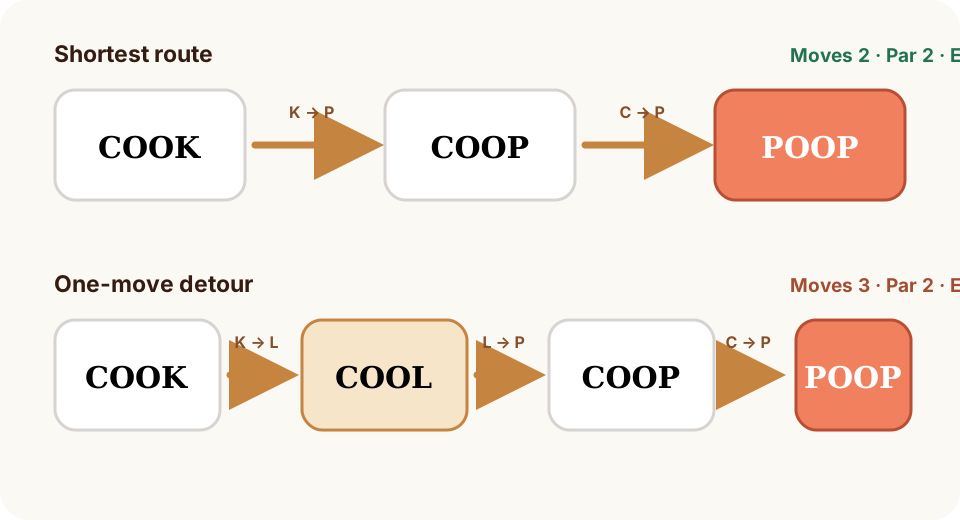
Here is a complete comparison from the same fixed start. The shortest route is COOK → COOP → POOP. The detour is COOK → COOL → COOP → POOP. Every edge in both rows is legal, but the second row adds an unnecessary edge before entering the same final lane.
| Route | Moves | Par | Extra | Why |
|---|---|---|---|---|
| COOK → COOP → POOP | 2 | 2 | 0 | Each move enters the final two-edge route. |
| COOK → COOL → COOP → POOP | 3 | 2 | 1 | COOL is legal, but it adds an edge before the same finish. |
Par is calculated over the complete accepted-word graph, not from one preferred editorial route. If two different paths have the same number of edges, both are shortest. The useful score to watch is Extra, which is simply Moves minus Par. Poople does not require you to beat Par, and there is no extra score for finding a route that is shorter than the mathematical minimum.
Common strategy mistakes
Several habits feel sensible but add moves in a word graph.
- Chasing visual similarity. Keeping the same letters in the same positions can feel safe, but a less similar word may be the bridge to a one-move finish.
- Assuming the first legal word is good enough. Legal only means the edge exists. It does not say the edge belongs to a shortest route.
- Committing to a rare word too early. A rare entry can be valid, but if you cannot name its next neighbor, it is a poor first choice for a human solve.
- Confusing draft editing with route control. Backspace changes the text you are preparing. It does not remove a submitted move. Use Undo for the route.
- Reading a hint as a free move. A hint narrows the next edge, but you still have to submit it. The first answer hint also marks a Daily run as assisted.
These are decision rules, not guarantees. A difficult start may have only one practical continuation, and a word that looks like a detour can be part of the true shortest route in another board. Let the accepted graph and the final Moves, Par and Extra values settle the comparison.
Recover without throwing away the run
When a branch stalls, use Undo to remove the last submitted edge and return to the previous word. The starting word cannot be undone. Restart returns the board to the start before the puzzle is finished. The input's Backspace key only edits the draft, so it does not replace Undo.
A hint is a controlled recovery tool. It can reveal the position to change, the replacement letter, and then a suggested next word. The suggested word can point back to an earlier word when that is the route that reduces the remaining distance. You still submit the move yourself.
Hints have a real result boundary. The first answer hint marks a Daily attempt as assisted, and Undo, Restart, refresh, or an in-browser retry does not remove that fact. An assisted completion counts as a daily completion and streak day, but it does not enter the no-hint step leaderboard. Use the hint when learning the graph, then replay the method in practice if you want to chase Extra 0.
Practise the method safely
Poople Unlimited is the right place to test a bridge-word idea without touching a daily record. It chooses from reviewed starts, saves the current practice route in the browser when storage is available, and keeps practice moves, hints, reveals and completions out of Daily standings. A new practice puzzle avoids the immediately previous start, although an earlier start can appear again later.
Use one practice attempt for each question:
- Can you name a word one move from POOP before you submit the first move?
- Did your next word keep at least one route toward that finishing word?
- When you finish, is Extra 0, or can you identify the edge that created the detour?
- Did a hint teach you a reusable connection, or did it only reveal a word?
Open Poople Unlimited practice to try the method. Return to the daily game when you are ready for a new board and a separate daily result.
Know what the result does and does not measure
Moves measures the edges in this one route. Par measures the shortest distance in the frozen graph for this one starting word. Extra tells you how far the route was from that minimum. Those numbers do not claim that one player is better at English, that a route is elegant, or that a future board will have the same shape.
Daily and Unlimited also answer different questions. Daily records the first confirmed run for the UTC date, with assisted completion kept separate from the no-hint leaderboard. Unlimited is for repeating the decision and trying another route. Practice does not backfill an unfinished day, replace a Daily result, or create an entry on the Daily board.
The date boundary is 00:00 UTC, which is 08:00 in Beijing. If a daily result has not synchronised, the page can show a local outcome while the server confirmation remains pending. It is safer to retry than to assume a streak or leaderboard entry was saved. There is no account recovery promise, so the browser and the confirmed server record are separate parts of the experience.
Poople strategy FAQ
What is the best Poople strategy?
Work backward from POOP, then choose legal bridge words that keep more than one useful route open. The closest-looking word is not always the shortest path. The accepted word list decides which candidates are legal.
Does changing a vowel first always give the shortest Poople route?
No. A vowel change often opens a useful word family, but it is a heuristic rather than a guarantee. Par is the shortest distance in the complete accepted-word graph, so the route must be checked against real legal neighbors.
What do Moves, Par and Extra mean in Poople?
Moves is the number of submitted edges from the starting word. Par is the mathematical shortest distance to POOP for that board. Extra is Moves minus Par. A route with Extra 0 is a shortest route, while any longer valid route still reaches the target.
Do hints or Undo change a Poople result?
Undo removes the last submitted move and Restart returns to the start. Neither erases hint use. A hint reveals a position, then a replacement letter, then a next word. The first hint marks a daily run as assisted, which keeps it out of the no-hint leaderboard.
Can I practise a Poople route without changing my daily score?
Yes. Poople Unlimited uses a separate reviewed practice pool. Its moves, hints, reveals and completions do not write to the Daily leaderboard or completion streak.
Keep the target in view
Shorter Poople routes come from the same small loop: inspect legal neighbors, plan backward from POOP, choose a bridge that keeps the graph open, and compare Moves with Par after the finish. Use the fixed COOK example to check the arithmetic, then practise the decision in Unlimited before applying it to a fresh Daily board.